The shift toward a data-driven organisation is no longer optional in today’s business landscape; it is essential. Companies that effectively leverage data not only gain a competitive advantage but also enhance decision-making, optimize operations, and create new growth opportunities. Transitioning to a data-driven organisation is a journey that can be effectively structured into five transformative steps: Aspire, Mature, Industrialize, Realize, and Differentiate. ¹
1. Aspire: Setting the Vision
The first step on the journey to becoming data-driven is aspiration. The Aspire phase in the transformation to a data-driven strategy and organization is crucial to build a solid foundation. According to Simon Asplen-Taylor, three important key points are:
- Make the most of the first 100 days: The first 100 days are crucial to the success of the transformation. Use this period to set clear goals, build relationships with key people, and visualize progress and impact. This creates momentum and a strong foundation for further change.
- Focus on quick wins: Start with small, achievable projects that deliver results quickly. This builds trust and engagement within the team and with stakeholders. It demonstrates the value of a data-driven approach and motivates further steps.
- Don’t be too ambitious: Focus on achievable goals within the first few months. It’s important to show ambition, but not at the expense of realism. Over-planning can lead to delays or failure, which damages trust.

Key deliverables during this phase include a high-level roadmap and clear metrics for success, such as increased customer satisfaction or operational efficiency.
2. Mature: Building the Foundations
In the mature phase of a transformation to a data-driven strategy and organization, complex and mature processes are implemented to extract maximum value from data. According to Simon Asplen-Taylor, three key points are:
- Single Customer View (SCV): A fully integrated view of the customer is important to deliver personalized and consistent customer experiences. This requires that data from different sources is merged into a single source of truth, allowing organizations to better predict and serve customer needs.

- Data Governance: Implementing data governance is essential to ensure consistency, compliance, and reliability in data usage. This includes clear guidelines, responsibilities, and standards for how data is managed and shared within the organization.
- Data Quality: A successful data-driven organization cannot do without high data quality. This means that data must be accurate, complete, and up-to-date. Poor data quality can lead to incorrect insights and strategic mistakes, making consistent monitoring and improvement necessary.
The maturity phase aims to create a scalable foundation that supports ongoing growth. Successful organisations ensure that data is not siloed but shared across departments to promote collaboration and innovation.
3. Industrialize: Scaling Data Initiatives
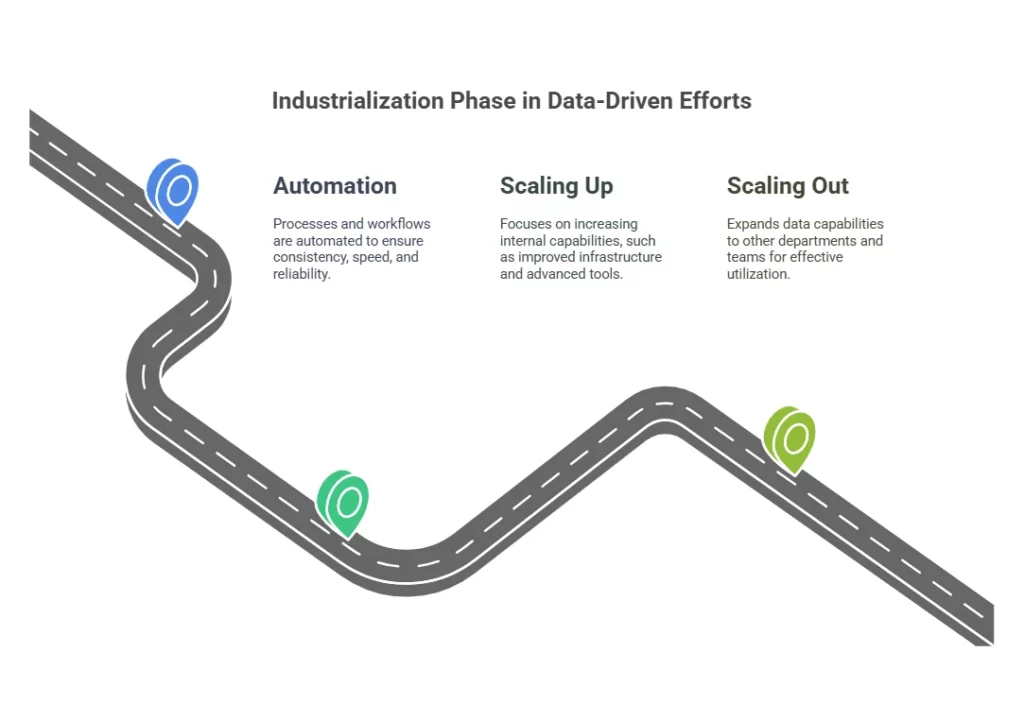
Industrialization is where data-driven efforts begin scaling across the organisation. The key focus areas in this phase include:
- Automation: Processes and workflows are automated to ensure consistency, speed and reliability. Automation minimizes human error and makes the organization more agile, making insights available faster and at greater scale.
- Scaling Up and Scaling Out: This involves expanding data capabilities to support the growing needs of the organization. Scaling up focuses on increasing internal capabilities, such as improved infrastructure and advanced tools. Scaling out is about expanding to other departments/business units and more teams to effectively utilize data.
- Optimizing: In this phase, existing processes and systems are continuously evaluated and improved. Optimizing data flows and analytics helps maximize value and minimize waste. Efficiency is key, both in terms of cost and performance.
Industrializing data practices ensures consistency and efficiency, allowing organisations to focus on generating actionable insights rather than managing data manually. For instance, a retail business might automate its supply chain analytics, ensuring that inventory levels are optimized in real-time.
4. Realize: Achieving Tangible Results
In the Realize phase, organisations move from preparation to action. Data-driven initiatives are put into practice, yielding measurable business outcomes. This phase includes:
- Voice of the Customer: In this phase, it is important to use data to better understand customer needs, expectations and experiences. This includes advanced analytics to integrate customer feedback into decision-making and strategies, improving customer centricity.
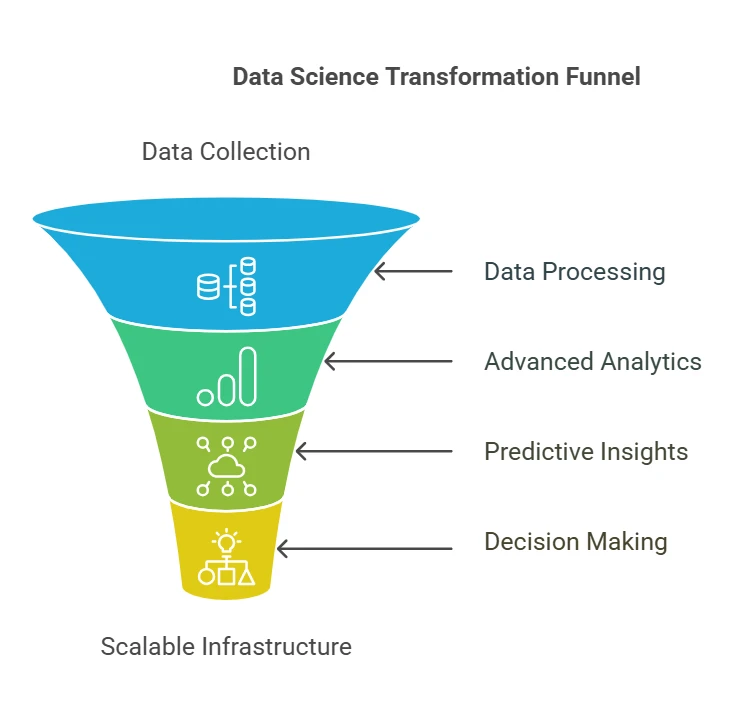
- Maximizing Data Science: Leveraging advanced data science methods, such as machine learning and AI, can be a great asset. This enables organizations to generate predictive insights and make better decisions. This phase also involves investing in scalable infrastructures to enable data science at scale.
- Sharing Data with Suppliers and Customers: Collaboration through sharing data with external parties, such as suppliers and customers, creates a broader ecosystem. This leads to improved supply chain efficiency, greater transparency and valuable partnerships. Trust and governance around shared data are a must.
At this stage, organisations should actively communicate successes to stakeholders to maintain momentum and further embed data-driven thinking & working into the culture.
5. Differentiate: Leading with Data
The final step is differentiation, where the organisation transforms data into a source of competitive advantage. This involves:
- Personalisation at scale: Using customer data to deliver hyper-personalized experiences. For instance, streaming services like Netflix differentiate themselves through tailored content recommendations.
- Innovating with data products: Developing new revenue streams by creating data-driven products or services, such as predictive analytics tools for clients.
- Adapting with AI: Moving beyond data-driven to AI-driven strategies, leveraging artificial intelligence to predict trends and automate decision-making.
Differentiation is not just about using data but creating value that competitors cannot replicate. It positions the organisation as a leader in its industry, setting new benchmarks for innovation and efficiency.

Challenges and Best Practices
While the 5-step framework provides a clear roadmap, organisations must navigate common challenges, such as:
- Resistance to change: Overcome this through strong leadership and continuous communication about the benefits of data-driven practices.
- Data silos: Promote collaboration and data sharing across departments to avoid fragmentation.
- Talent gaps: Invest in hiring and training talent skilled in analytics, machine learning, and data engineering.
Best practices include maintaining a customer-centric focus, regularly updating data governance policies, and fostering an agile mindset to adapt to evolving business needs.
Conclusion
Becoming a successful data-driven organisation is a transformative journey requiring strategic vision, strong leadership, and a commitment to continuous improvement. By following the five steps—Aspire, Mature, Industrialize, Realize, and Differentiate—organisations can unlock the full potential of their data, delivering significant value to customers, employees, and stakeholders alike.
¹ Data Driven Strategy & Organisation by Simon Asplen-taylor